Soparnik is one of the simplest and most delectable Croatian dishes. You can think of it as Croatian pizza or a kale pie. But let’s unravel these comparisons to whet your appetite.

Why Croatian pizza?
The first time I had soparnik, I crashed a village party in Poljice. The dish was made for a group of German tourists and I sneaked my way into the hungry crowd. When soparnik arrived on a large wooden board, German youngsters explained: ‘Pizza is here!’.
I immediately frowned. ‘This is nowhere near pizza’, I began explaining, slightly annoyed at their rushed comparison. But the more I thought of it, the easier it was for me to agree.
Soparnik is made of simple dough - just flour, water and salt. Unlike pizza, it’s not even proofed. But the filling ticks all the boxes a classic pizza should. It’s cheap, available and delicious.

We could say that soparnik is a kale pie. Because in the local dialect, kale (zelje) means dark leafy greens. But there is no actual kale inside the two sheets of dough. Soparnik is filled with a mix of Swiss chard and onions.
Poljica, the area inland from Omiš, is the cradle of soparnik. This is where the unique baking technique was invented - a touch that gives soparnik its magical aroma.
Once the soparnik dough is rolled out and filled, it goes straight onto the hot hearth. Embers are placed on top so the dough is fully buried underneath. When soparnik is done, it comes out all dusty with beautiful dark brown specks.
Just like with pizza, it’s the baking technique that matters. But there is a way to make soparnik in your home oven. This recipe will teach you how.
Why is Croatian soparnik so special?
Although soparnik is protected as Croatia’s intangible cultural heritage, it’s almost impossible to enjoy it in Croatian restaurants.
Even in Poljica and nearby villages, this savoury pie remains elusive. The locals told me, ‘This is because no one will make it for just two people’.
If you’re set on sampling soparnik, this hunt for it could get annoying. Why so much talk if you can’t eat it at every corner in Croatia?
But once you get lucky enough to share a slice with the locals in Poljica, you’ll understand the deeper meaning of this green pie.

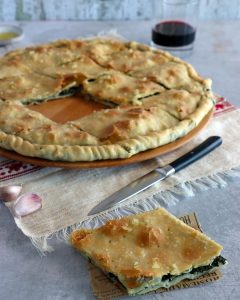
Soparnik (zeljanik or uljanik) was always food for the community. When a gigantic wheel of dough arrives from the hearth, it is sliced into diamond-shaped portions. The middle ones (usually 4) are removed and replaced with a glass (bottle) of wine. You are invited to reach for your share of soparnik only after everyone has a sip.
In Poljica, soparnik was lunch for those working in the field. To add substance to the light Swiss chard and onion filling, the pie’s crust is bathed in garlicky olive oil, a taste that lingers even when you must return to your chores. It encapsulates Dalmatian food just right.
Croatian Savoury Baking cookbook
50 step-by-step recipes for bread, burek, pies, pastries and snacks. 288 pages, 500 images & expert baking tips
Now that you know the whole ritual of eating soparnik, it’s time to bake it at home. Here comes my soparnik recipe.
Browse other recipes in my library.
Oven-baked soparnik recipe

Soparnik
Ingredients
For the dough:
- 500 g bread (strong) flour, plus more for rolling (4 cups )
- 7 g salt (1 tsp)
- 270 ml water, lukewarm (1 cup + 1 tbsp)
- 20 ml olive oil (1 ½ tbsp)
- 7 ml apple cider vinegar (1 tsp)
For the filling:
- 350 g Swiss chard, cut into strips (0.8 lb)
- 1 small onion (finely chopped)
- 12 g salt (2 tsp)
- 20 ml olive oil (1 ½ tbsp)
For the coating:
- 3 cloves of garlic (minced)
- 20 ml olive oil (1 ½ tbsp)
Instructions
- Sift the flour into a bowl. Add the salt and blend evenly with a hand whisk.

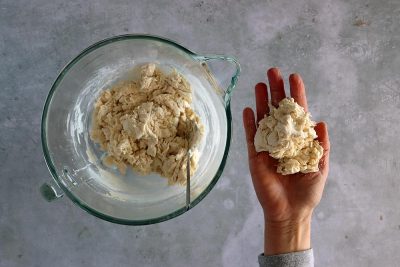
- In a separate bowl, combine water, oil and vinegar. Pour this liquid into the flour and mix with a spoon to make a rather shaggy dough.
- Switch to a stand mixer with a dough hook and work the dough for 5 minutes at medium speed until it becomes a smooth ball that doesn’t stick to the sides of the bowl.
- Turn the dough onto your kitchen surface and give it a few kneads.
- Divide the dough in half. Shape each piece into a ball and wrap them in cling film. Leave them to rest at room temperature for 1 hour.
- In the meantime, prep the Swish chard by removing the white stalks (you can save them for a different dish). Cut the leaves into thin strips. Wash them thoroughly and shake off excess water. It is best to run them through a salad spinner.
- Finely chop the onion and add it to the Swish chard. Season with salt and olive oil, and combine.
- Preheat the oven to 200 °C (400 °F).
- Take a round baking pan and turn it upside down. Cut out a piece of baking paper that fits on the pan. Set aside.
- Roll out the first piece of dough into a round shape, just slightly larger than the lined pan. The dough should be about 2 mm (0.08 in) thick. As you roll it out, flip it over several times and use that additional flour whenever it starts to stick.
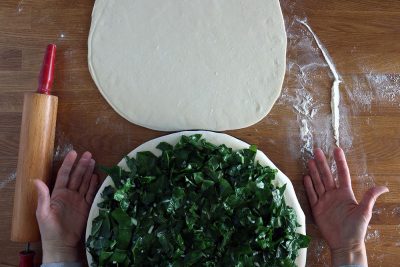
- Place the rolled-out dough on the lined baking pan. Spread the filling evenly on top of the dough.
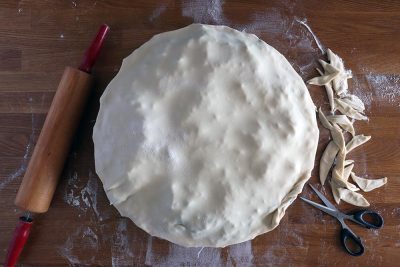
- Roll out the second piece of dough and place it on the filling. Cut off any bits of either layer that are thick or overhanging.
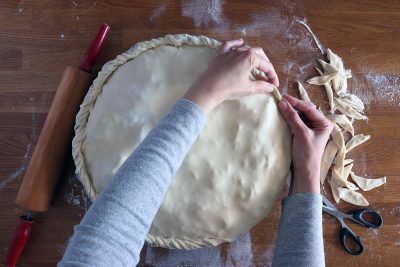
- Going around the dough, pinch and twist the bottom and the top layer of the dough together to get a wavy seam. Poke the top all over with a toothpick or a fork.
- Bake for 30-35 minutes. The soparnik will inflate as it bakes at some point, but it will quickly come down. This is why we poked the dough beforehand.
- Take the soparnik out and slide it onto a large wooden board. Remove the baking paper from underneath.
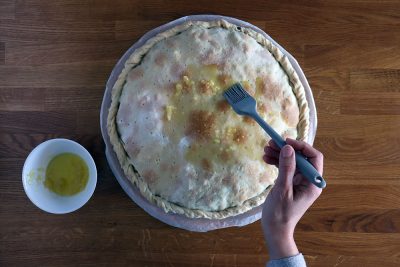
- Combine the minced garlic with olive oil and brush the top of the still-hot soparnik with it.
- Leave to rest for 10 minutes. Then cut the soparnik into diamond-shaped pieces. Use a pizza wheel knife or a regular bread knife. Eat warm or cold but on the same day.